SoftEther VPN is free, cross-platform, multi-protocol, open-source VPN software. It was originally developed in 2003 by Japanese student Daiyuu Nobori at the University of Tsukuba as part of his master's thesis research.
History
As the project developed, it attracted the attention of Japanese corporation Mitsubishi Materials Corporation, which entered into a ten-year agreement to support the release and distribution of the software. After the agreement expired in January 2014, SoftEther VPN was released under the free GPLv2 license, making the software available to everyone.
SoftEther's history also includes a controversial period in Japan, where its use was reportedly restricted amid concerns from authorities about the software's potential misuse.
Technical Characteristics
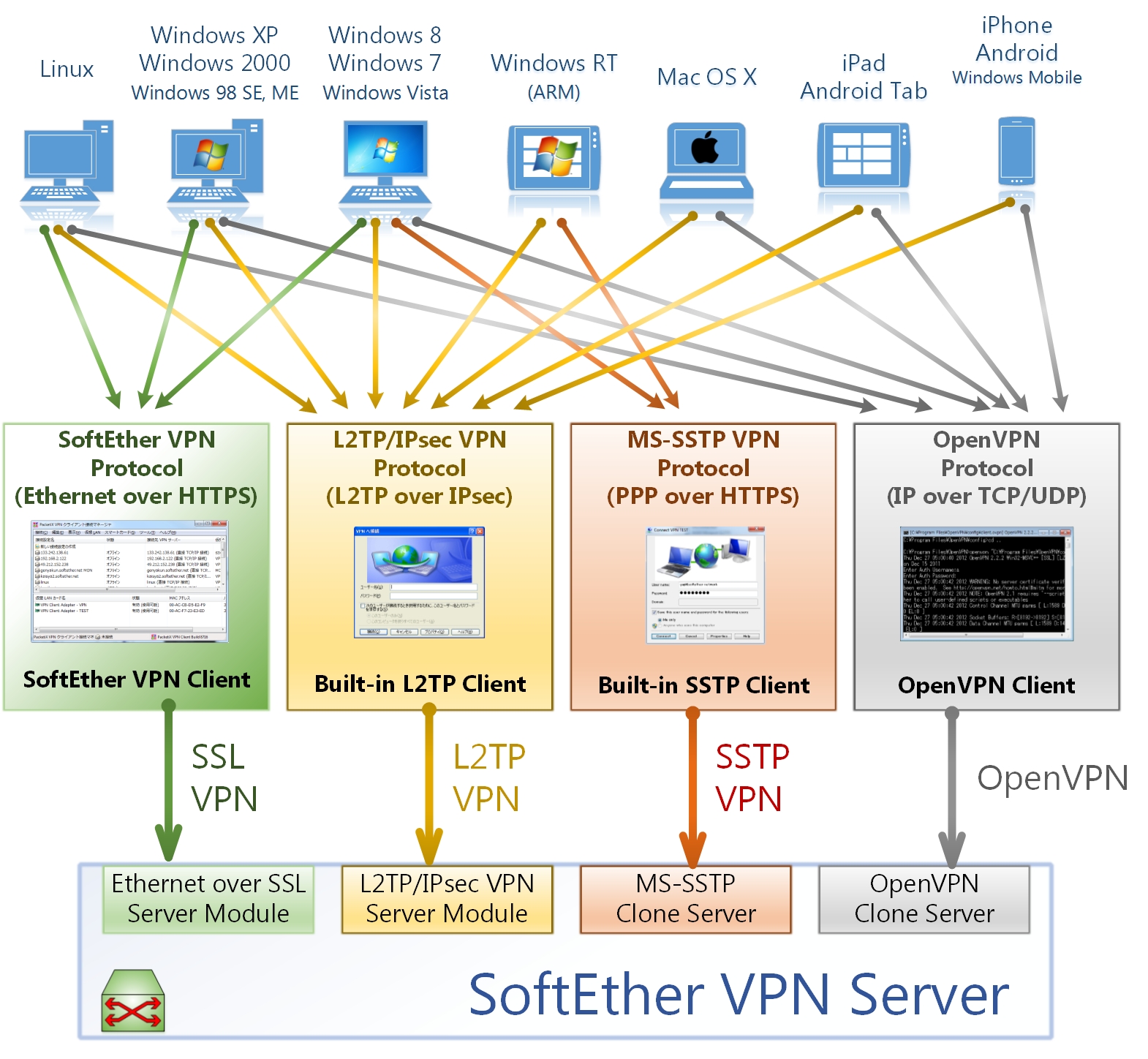
- SoftEther supports many widely used tunneling and VPN protocols, including L2TP, L2TP/IPsec, MS-SSTP, and EtherIP. Multiple protocols can be enabled simultaneously on a single server;
- L2TP support provides compatibility with iOS and Android, allowing users to connect to a SoftEther VPN server using the operating system's built-in VPN functionality without installing an additional application;
- includes its own SSL-VPN protocol, which encapsulates VPN traffic in HTTPS-style connections, making it resemble ordinary HTTPS traffic to many firewalls and network filters;
- supports TCP NAT traversal and TCP hole punching, which can help establish connections through certain types of NAT and restrictive network environments.
The SoftEther VPN software package includes several components:
- VPN Server is the main server component. On Windows, it is distributed together with VPN Server Manager and can also provide the functionality of a VPN Bridge;
- VPN Bridge is used to connect local networks to VPN tunnels;
- VPN Server Manager is a graphical administration application for Windows. It allows administrators to manage both local and remote VPN servers and is installed separately;
- vpncmd is a command-line administration utility that can be used in Unix-like terminals as well as the Windows command prompt. On Unix-like systems, it is installed with the server package; on Windows, it is included with the VPN Server package;
- VPN Client is the end-user client used to connect to VPN networks.
Advantages of SoftEther
One of SoftEther's main advantages is its ability to operate in restrictive network environments. Many DPI (Deep Packet Inspection) systems used by Internet service providers to inspect network traffic may have difficulty identifying SoftEther's SSL-VPN traffic as a VPN tunnel because it can be encapsulated to resemble ordinary HTTPS traffic. SoftEther also supports multiple transport mechanisms and tunneling techniques, making it highly flexible in environments where conventional VPN traffic is restricted. This flexibility has contributed to its popularity in countries with extensive Internet filtering, including China.
SoftEther is also relatively straightforward to deploy and administer on a server. It has modest hardware requirements and can run on a wide range of virtualized environments, including inexpensive VPS servers. Unlike some VPN implementations that depend on specific kernel-level networking features such as TUN/TAP support, SoftEther can be deployed without the same virtualization requirements. On Unix-like systems, the installation process can be performed by compiling the source code with a relatively simple build procedure.
Server administration is also made easier by the vpncmd command-line utility, available on both Unix-like systems and Windows, as well as the dedicated graphical administration application for Windows.
SoftEther VPN is distributed under an open-source license, allowing its source code to be inspected, modified, and redistributed in accordance with the terms of the GPLv2 license.